It has been said of Helmut Lang that he was the Marquis de Sade and Audrey Hepburn occupying a single wardrobe — the harness and the shift, restraint and grace, filed under one label and never reconciled. The line survives because it is structurally true: Lang's whole method was to hold two incompatible readings open and decline to close either.
Juan Camilo Suarez is not that. Suarez — twenty-nine, Colombian, three collections deep and signing everything with three initials — is a structural engineer and a hospice nurse sharing one pair of hands. One half calculating what will bear load; the other sitting with what is visibly ending and declining to tidy it up. Every garment he has made is a calculation and a deathbed.
He works from Bogotá, which matters more than it sounds. At 2,640 metres the light is northern-European in temperature and equatorial in duration: cold, flat, relentlessly available. It is an overcast Rotterdam afternoon that never ends. Half of Tikuna is dressed for a climate that exists nowhere except above 2,500 metres, and the other half for the coast four hundred kilometres away. The house is bilingual in weather before it is bilingual in anything else.
IThe Declared Seam
The initials are the whole identity. No wordmark, no logotype, no name spelled out anywhere on a garment — three letters that happen to be his, and happen also to be the count of the houses he has been reading.
Because he did not take their clothes. He took their arguments.
Lang's argument: the seam is load-bearing. Strip everything and what remains must work. A buckle that fastens nothing is a lie. The harness is not decoration resembling function — it is the reason the garment stays on the body, and its erotic charge is a side effect of that honesty, not the point of it.
Saint Laurent's argument — carried out of Dior, where the boy from Oran cut the 1958 Trapèze at twenty-one and briefly held the most consequential job in Europe: the seam is drawn. The Trapèze is not a shape, it is a proposition about volume, a rumour about a body, deliberately unconfirmed. And in the Mondrian dresses of '65 he found the trick that defines the lineage — the seams are simultaneously the structural darts and the black grid-lines of the composition. Construction is the graphic. Nothing is applied. The dress is the ornament of its own making.
Margiela's argument: the seam is confessed. Exposed overlock, shoulder pads left showing, the lining out, the hem unfinished. Not error elevated to style — a refusal of closure, in the strict Derridean sense, applied to garment structure. The clothes will not stop meaning. They decline to end the way a sentence declines to end.
Suarez's question: what is a garment allowed to admit about itself? His answer is the most demanding proposition in fashion at the moment, and he prints it at the bottom of the catalogue like a dare:
Every garment contains exactly one seam that is simultaneously load-bearing, compositional, and unfinished.
Remove it and the garment fails. Cover it and the composition collapses. Finish it and the garment lies.
Adolf Loos published Ornament and Crime in 1913 and Vienna has been arguing with itself ever since. Suarez inverts him. Loos wanted ornament removed; Suarez wants it promoted to structure — the only decoration permitted is the thing holding the garment together.
This is not minimalism. Lang was blunter than his critics: “minimalism starts with baroque.” You build maximal, then reduce until exactly one event survives. Emptiness must be visibly earned or it is merely empty.
The palette obeys the same economy. Void as ground — the most-weighted value across the entire archive. Bone as relief, the single warm note, rationed. And Trace, the oxide red, which appears in one place only: the declared seam, and nothing else.
IITikuna
Collection 02 · Women's Summer 2026 · Looks 40–79
Gottfried Semper, 1851: architecture did not begin with the wall. It began with the textile — the woven hanging, the Bekleidung, the dressing. The wall came later and was always, ontologically, a curtain that got serious. Fashion has cited Semper for a century without noticing he was arguing the opposite direction of travel from the one it wanted.
Suarez noticed.
Tikuna asks: what does a garment do with the distance between cloth and skin? Lang compresses — zero gap, cloth on skin, latex-dipped cotton. Saint Laurent suspends — the Trapèze hangs from the shoulder and the body underneath is a rumour. Margiela displaces — the size-74 Semi-Couture, the dress-form bodice, cloth cut for a body that is not present.
The rule: one garment, three distances. Pressed at zero centimetres, suspended at two to eight, displaced at fifteen and beyond, read top to bottom, transitions visible. Hide the transition and the garment fails.
This is Merleau-Ponty's body schema made literal and then made rude. The lived body extends past the skin; the garment is where that extension becomes negotiable. Suarez turns it into a spec sheet, which is either vulgar or the most rigorous thing done with phenomenology since Husserl put down his pen.
The season's switch register is not a colour but a state: sheer. A look is entirely transparent or entirely not — never partly. Saint Laurent's 1968 transparence blouse applied as a binary rather than a flourish.
IIIKarijona
Collection 03 · Men's Autumn 2025 · Looks 80–119
The question autumn forces: when is the garment from?
Lang: not yet. 3M retroreflective, plastic-stiffened canvas, materials that did not previously exist. He also cancelled a physical show in 1998, put eighty-one looks online instead six weeks ahead of Paris, and permanently broke the calendar. His clothes arrive from a future that has not been ratified.
Saint Laurent: always. “A stylish garment and not a fashionable garment.” Le Smoking, the trench, the peacoat, the saharienne — his own 2002 valedictory named his legacy as a list of garment-types, not a decade. The permanent present tense.
Margiela: already. Replica, reproduced from found originals including their repairs. Artisanal, objects with a prior life. Wear that is not distressing but history.
Suarez: all three at once, one per component, none of them winning. A silver bonded shell over near-black worsted over a shirt whose collar has genuinely frayed. The transitions must stay legible — a technical fabric washed to look old is a failure, because it resolves. Three witnesses to the same event, refusing to agree.
He is strict about wear in a way that reads as ethics rather than styling: it must be located. Darned at both elbows. Patched at both knees. Shiny at the seat. Faded down one side only. Generalised distressing is banned outright — it reads as a finish, and a finish is a lie about time.
IVMiraña
Collection 04 · Women's Spring 2026 · Looks 120–159
Spring asks the question the other two set up: who finishes the garment?
Lang hands it over — “Clothes are an adaptive surface. They shouldn't define you. You are the identity, the clothes adapt.” Saint Laurent takes it away: the five-act atelier ritual, proportion fixed by the workroom, the final fitting under infinite rigour, nothing left to decide. Margiela never makes the decision at all — raw, unlined, unfaced, the blank label refusing even authorship.
So: three hands per look. One element only the wearer can set, with genuine travel and no single correct configuration. One the atelier has closed absolutely. One nobody finished. The switch register is an entire outfit held together by visible tailor's pins and paper pattern tags, no stitching anywhere — the atelier caught between acts, before any hand has committed.
A word about the names, since a critic who skipped it would be doing the house a disservice. Tikuna, Karijona and Miraña are Amazonian nations, two of them with languages under real pressure. The archive that Suarez built his method from contains, among the Saint Laurent material, the standing critique of that house's “exotic” vocabulary — assembled from books and paintings, never travel; Florence Müller's verdict that “Saint Laurent's travels were essentially imaginary ones.” Suarez has read it. A Colombian designer naming collections after Colombian nations is a materially different act from a Frenchman naming a collection Bambara, and it is also not automatically innocent. The house's own method says: hold the two readings open, refuse to close either. On this one, that refusal is doing more work than it should have to.
VFour Objects, Looked At
Theory is cheap. Here are four garments described by somebody standing in front of them.
Look 49 — “Rain Cape”
Tikuna. Coated cotton, grey, no shoulder seam anywhere, pressed to the body only at the neck and standing thirty centimetres clear at every other point. Still, it is a bell. Walking — and the house films everything walking — it stops following the body and begins negotiating with it, the hem arriving a half-beat after the hip. It is the clearest proof in the archive of what Tikuna is about, and it only exists in motion, which is presumably why Suarez films.
See the look →Look 100 — “Darned”
Karijona. A brown shetland worn as outerwear with a diamond darn at each elbow in slightly-off contrast wool — the repair a competent grandmother makes, not a designer's simulation of one. The knit sleeves stop below the elbow and a silver technical bomber comes through beneath and continues to the wrist. A single arm therefore carries all three ages in sequence: mended wool, then a fabric not yet obsolete, top to bottom in twenty centimetres. The bomber's hem shows again below the knit. Wide dark trousers, split-toe derbies. The whole thing looks like a man who dressed in a hurry and accidentally told you his entire life.
See the look →Look 119 — “Declared Ages”
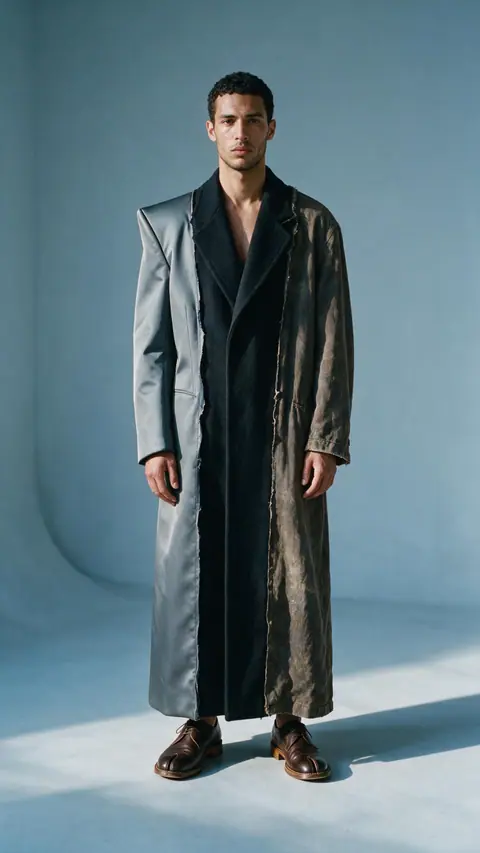
Karijona, finale. One floor-length greatcoat in three vertical panels: silver bonded technical at the left, black wool at centre, sun-rotted brown canvas at the right. The seams between them are raw and fraying. It is a garment containing its own past and future across a single width, refusing to blend them. A coat that is three coats and admits it. If the house is ever reduced to one object, this is the object.
See the look →Look 156 — “Knot”
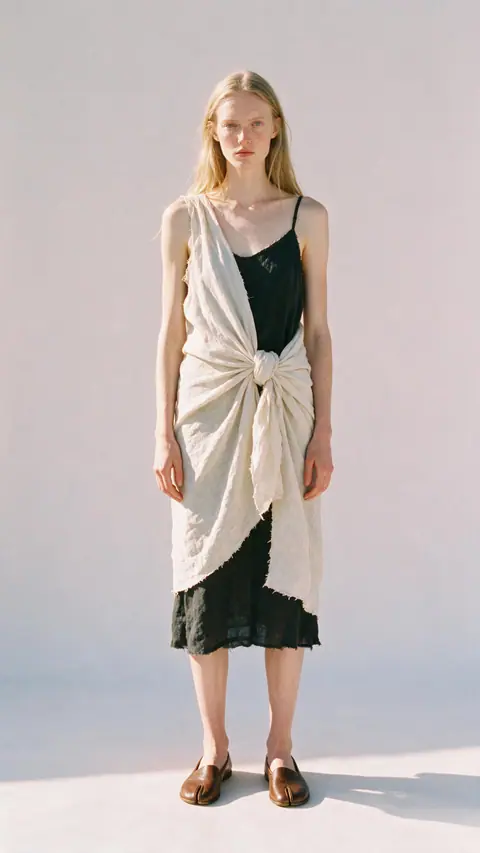
Miraña. A single length of undyed linen, raw on every edge, wrapped over a black slip and tied once at the waist. That knot is the only closure and the only decision, and it belongs to the wearer — untie it and there is no garment, only cloth. The linen frays along every cut edge and catches light the way finished hems never do. Beneath, the slip is atelier-closed, precise, unadjustable. Three degrees of finish in one silhouette, and the silhouette is a toga that has read Derrida.
See the look →VIWhat the Machine Saw
Suarez ran all one hundred and twenty looks through a vision-language model and kept the transcripts. He shows them to people. It is the most contemporary thing about him and also the most Margiela: the anonymous reader, the collective we, the refusal of the author's eye as final authority.
The machine is a spectacularly unreliable narrator, which is the point.
Of look 119 — the three-age coat, the entire thesis — it reports:
Machine transcript · Look 119“He is wearing a long, grey coat with a black collar and cuffs. The coat is made of a shiny, metallic material and has a high collar.”
One material. It sees three ages fused into a single surface and calls it metallic. The concept is invisible to it. It sees a coat.
Of look 84 — a whole outfit in 3M retroreflective, flat grey by day and blazing silver-white under flash:
Machine transcript · Look 84“White pants with a geometric pattern and black sneakers.”
The blowout is not a material behaviour to the machine. It is a print. Retroreflection, Lang's one genuine invention, read as decoration. An eye that cannot perceive time reads a temporal event as a pattern.
And of the voile column, look 61:
Machine transcript · Look 61“A long, flowing white dress with a one-shoulder neckline… The overall mood of the image is elegant and sophisticated.”
Elegant and sophisticated: the two words this house has spent three collections trying to make impossible.
Across all one hundred and twenty looks, the model never once identified the split toe — the Tabi lineage in every shoe the house has ever put on a foot. Not once. The most consistent piece of DNA in the archive is, to the machine, simply absent.
Suarez keeps the transcripts because they map what a garment communicates to someone who does not know the argument. The clothes survive that reading. The thesis does not. He seems to find this reassuring, which tells you how much he trusts the object over the explanation.
VIIThe Room
The shows happen in a hall Suarez commissioned rather than rented: bush-hammered board-formed concrete, tinted a very pale grey-pink that reads as light rather than as colour. One wall turns through a continuous radius and meets a razor-square pier. A linear skylight slot runs the corridor's full length; a circular oculus drops one ellipse of hard sun onto the floor of the curved apse.
Kahn said the room is the beginning of architecture. Zumthor built Vals so the stone would tell you what temperature to be. Ando pours concrete so that a slot of light can cut it. Suarez has built a room in which the two geometries his clothes refuse to reconcile are also the walls — curve and corner, continuous and abrupt, same space, same light source, resolving nothing.
No raised runway. Lang's Séance de Travail — the work session, ground level, flat floor, clothing completed by the wearer. The floor is chalk-painted, and every shoe in the house has an oxide-red sole, invisible standing. Over the course of a show, the walkers mark the floor.
That floor, empty, afterwards, is the campaign image. Not a look — the residue of the looks. Margiela's red-paint Tabi footprints at the Café de la Gare in 1988: ninety minutes reduced to the evidence that bodies moved through a room.
Semper was right. The wall was a textile first. Suarez has run the argument backwards until the textile became a wall again, then walked women across it at a hundred and eight steps a minute.
VIIIFind the Declared Seam
Three collections, three questions, no answers. One garment three distances; one look three ages; one look three hands — and beneath all of them, always, one line doing three jobs at once.
Ask Suarez what the house stands for and he gives you the label instead: blank white cotton, four visible exterior stitches at the corners, a serial stamped in the centre, no wordmark anywhere. The stitches attach the label. They are also the only graphic. They are also raw.
Even the label obeys the seam.